Before watching
I have only seen one Ingmar Bergman film (Wild Strawberries), and if I’m honest there’s no reason why it’s the only one I’ve seen. Sadly at this point (10+ years later) I don’t remember almost anything about the film except for how much I loved it, and not mindlessly, but really, truly loved it to its core. My initial expectations for Three Strange Loves are pretty high, for both my overall enjoyment of the film and the moral background. Although I’m aware of the 3.5 star viewers’ rating that jumped at me as I was choosing the film.
After watching
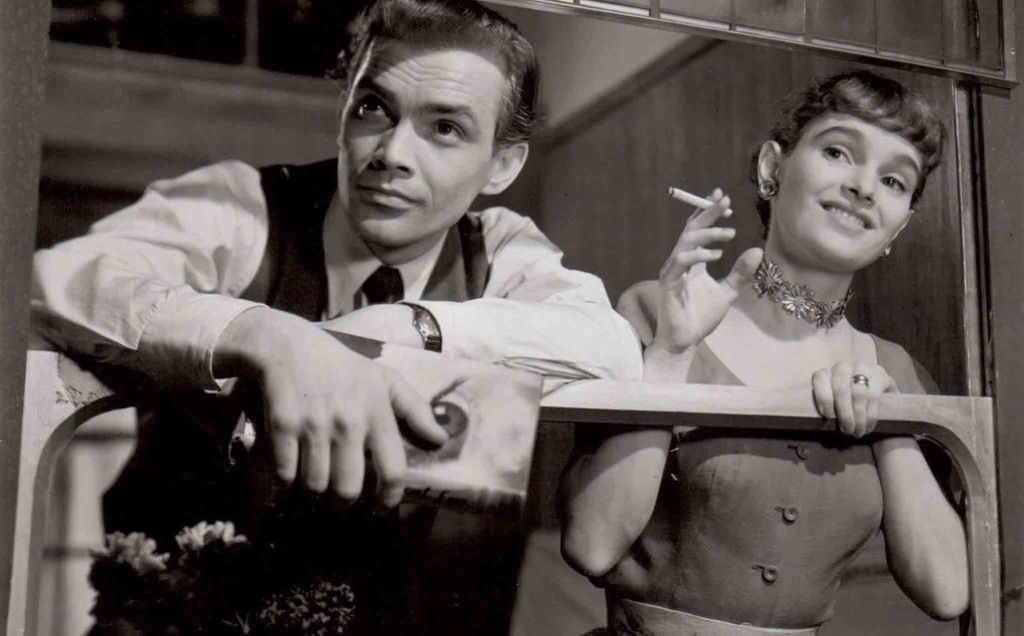
It’s interesting to note that the original title in Swedish is Thirst, which I found appropriate in the “thirst for something that’s not there” sense throughout the film. The title adopted in the UK is Three Strange Loves, and while I agree that the love stories expanded on are strange in some sense (not as uncommon as you could hope though), the maths really threw me off. I felt like there was two main storylines, plus quite a few (not one!) side stories intertwining the main two. But three loves?! More like either 2 or 5! I have more things to say about the film, but just needed to get this very important calculation error out there…
The balance of the stories told was quite off in my opinion. I never got a feeling of a good flow in the film, and this was definitely not due to direction. The acting and the pace were so good that I’m now remembering watching Wild Strawberries and being pleasantly surprised how the film gripped me, even though an old black and white foreign film would probably not elicit that expectation. I can absolutely see the underlying plot being interesting as a book of short stories (which I think it was), but not quite as a film. Although I think this film was the best possible transition of those tales onto a cinema screen.
Thoughts | Lessons | Reminders
“I am an honest person, I’ve never tried to hide that I have two women! A sound man has to have two women.”
This line was said with the utmost confidence, after being caught, to the two women in question. It turns out that with enough confidence you can say anything you want, and until there’s context, it’s all very easily believed.
Lesson for me: I tend to be the first one to doubt the validity and often the worth of what I’m saying. Not to say this is to be used with stupid statements like the above quote, but I was shocked how the self-assured delivery of this line made me first think “Am I the backwards-thinking one here?” …Oh the difference that me making statements in a confident manner could make to people perceiving me differently.
“What use is a heart to a dancer who can’t use her legs?”
There are two ways of thinking about this, and Ruth here clearly chose to wallow in her misery. Humans are a resilient race – I used to dance and also had an injury that stopped me from carrying on altogether. It hurt for so long to have to say goodbye to that awfully important part of my life, but eventually it seemed silly not to get used to living differently, as opposed to longing for the old ways.
Reminder for me: No lesson here, just a pleasant reminder that I’ve chose the right path. Ruth ended up holding so much bitterness towards everyone around her that she poisoned herself and her marriage, and seemingly any chance of being happy with what she’s got.
“Pure wishful thinking! The two sexes can never be united. They’re separated by a sea of tears and misunderstandings.”
Not always, but when they are, can’t it sometimes be a great union nevertheless?
Reminder for me: Again, not necessarily a lesson, but a reminder that I’m not one for strong views. I feel slight self-loathing after any definitive statement I make (aren’t they just so pretty? So assured and confident and magical… and rarely true), because I’ve grown up learning to defend both sides of the argument, and solving problems on a case-by-case basis, not by offering a one-size-fits-all solution that can be contained in a (rhyming?) quip. While this often makes me feel pretty reasonable, especially in our golden age of opinionated madness, it’s a hard thing to resist. It’s hard to grip people by saying “I can see merit in both sides”. Our weak attention span is destroying the ability to listen on, after not perceiving a clear opinion from the first statement.
“Admit that your whole life has been one long mistake.”
Said the psychiatrist to a grieving widow. No, this is not a joke, this was an absolute shock of a doctor, trying to sleep with his patient. I listened to the whole exchange in disbelief, during which I’ve started seeing that again, with enough confidence, and using the shock factor in your favour, you can certainly make people believe the craziest things.
Lesson for me: Although I do love hearing the other side of any opinion that I hold, I can certainly see how by exploiting the reason in us (“The statement is so ridiculous, why would they be lying to me – hence this must be the truth and I best open my mind to this mad idea!”) some pretty crazy ideas can be brought to the table. The lesson is not to let people get away with insane rhetoric.
“Oh yes, you talk quite a lot, but in fact you say nothing. What are you holding back? What are you keeping from me? Just be normal!” /
“I talk and go on like a machine gun. It’s because I’m afraid of the silence.”
I feel like in the past few years I’ve definitely gotten better at not blabbering. It’s come over me like a wave of fatigue over words that mean nothing, and are only supposed to fill up (the uncomfortable) space. If I don’t know what to say, I now prefer not to say anything if I can. I used to be afraid of the silence, but now it’s just another thing in the room with me, I even quite enjoy it. It’s the holding something back part of the quote that intrigues me more, since it’s also true that by listening I forgo speaking. I often don’t speak because I’ve found that many people who enjoy quick conversations are uncomfortable with unexpected answers and undecided, inbetween opinions like mine. Telling certain people even the most insignificant facts about my life often feels deeply unpleasant, as I feel like I’m revealing more of myself than they deserve or are willing to understand. But it definitely feels like something that I need to learn how to do; communication is such a key part of human experience, and I feel like my skills in it are quickly deteriorating, partly as I’m becoming more comfortable with longer silences.
Lesson for me: This lesson is building on the first one. It’s about the importance of not talking meaninglessly, but even if less, then with more impact, as staying silent erases me from existence. It doesn’t need to be loud, it just needs to be confident and unwaivering in my (lack of?) position.
“Try to understand that the main thing isn’t to be loved, but to love.”
This will be hard to believe, but this sweet line was spoken by the psychotic psychiatrist. Of course it was followed by insane reasoning for how he is doing her a favour by being a kind, selfless volunteer who is ready to accept her love. And she shall give in. Now, forgetting this mad context, the truth in these words is so very powerful. First of all, because you can only control yourself and your feelings. When put like that, it sounds weird that we ever put our confidence or importance on the shoulders of someone else seeing you a certain way. In most things, the only truth is your truth, and even thinking about getting a consensus about the truth is exhausting, so why not just trust yourself to the only person you have power over? Why not be the decisionmaker?
Lesson for me: This is one of those things that I can keep telling my friends and loved ones a thousand times over, but find almost impossible to trust myself to love myself. I know the quote talks about way more than love towards yourself, and in any way it’s an excellent principle, but as we’re learning lessons here, the biggest challenge for me is loving myself. It might be because I know so many of my flaws and it feels like giving up when I try to accept myself with those flaws. It might be because I don’t quite understand what there is to love, because I don’t understand myself… but that’s just where the self-discovery in this blog should lead. So the lesson is as simple as I’ve always known it, while I’ll stay on high alert looking for ways to internalise its meaning.
“The stab of pain – what do you know of that?” “You tell me about it day and night.”
This is such a basic issue… assuming that everyone else has got it all figured out. That you are the one with the hardest life, with the most unsolvable problems. I approach this feeling with an excuse of sorts – instead of saying They have it better than me, I say to myself They are too good to be suffering from the same stupid issues as me. I put myself down more than I do other people, purely because it feels like a cruel assumption that others are leading miserable lives. And to round this off with an even more obvious statement: you can’t think of something that you don’t know exists if you don’t know it exists. While people I admire or think more highly of might not have the same issues as me, I’d say it’s a surefire statement that they have some other issues in their lives. But as much as I believe that, it’s hard to feel for others when not quite grasping their actual challenges.
Lesson for me: I don’t even know what to do here. I find it difficult to talk about challenges I face with anyone but a handful of people closest to me, so I can’t even do my part in spreading the word about “everyone has issues”. Not that people can’t guess by looking at me already! I’m joking only partially because I know I don’t exactly come off confident or care-free. In perceiving others I guess I can only try and imagine problems they might face, since I don’t think many people take too kindly to “tell me about your life challenges”.
“They’re so busy surviving that they have no time for a spiritual life. One could almost envy them!”
That’s exactly how I feel. It was lovely not to think about something so important for a long time, even though now I have all this catching up to do. It’s not awful, since I’ve found a pretty enjoyable way of making up for the lost time, but it was easier not thinking about it at all – obviously.
Lesson for me: When you’re not busy surviving, don’t leave your “spiritual life” on the backburner.
“No not rest, I daren’t rest – I have to feel rested to rest!”
This was one of the weird quotes that I expected to laugh at, but isn’t it so true when you think about it?
Lesson for me: Sleep is important, but it won’t be a good one if you keep stressing yourself out during the day.
“Nothing takes root in me anymore, it’s all muddy inside!”
That is also how I feel regarding the question of spiritual life. Because I’ve lost touch of what I am, I can’t tell apart things that I enjoy and don’t; things that I want to be/do/have or not.
Lesson for me: A clearer vision will aid in better growth.
“You took away my lust for life!” vs “It’s my fate to always meet hysterical women.”
This ever so slightly regards the love vs be loved quote. The control of our stories is ours, because the narrative you have in your head is the truth for you. It’s hard to keep thinking you’re a loser while not feeling like one. So when you create a negative narrative, it becomes unimportant whether it was originally true or not. It becomes the truth because it is your truth. I find this really challenging on a personal level, because I always feel like I’m cheating myself when I put a positive spin on a story of mine that originally had a negative connotation. In the two pretty bad examples in the quotes above I would still overcome the fixed thinking patterns and say “I need to regain my lust for life” and “I used to always meet hysterical women, but I think you could just be the turnaround” – oh isn’t this easy to do with other people’s problems?
Lesson for me: Be more mindful of how you think about your past. Bitterness will get you nowhere.
In conclusion
Even in this one post I felt like repeating myself a lot. At first I thought I’d promise to get my posts shorter and shorter as I’ll be revisiting themes I’ve already written about, but in fact now I think that writing about the same ideas will potentially help me internalise more of the lessons more effectively. So as this blog is mostly a self-administered therapy tool, unfortunately you’re in for more repetition than you’d potentially expect in a more reader-oriented blog.
To conclude about the film, this was a steady start with something not too great, but also definitely not too shabby. I’m sure I’ll be going both higher and lower in the quality of the analysed films in the next year.
Until the next time,
Jake

